Ad Astra AIBook a 30-minute scoping call
AI hardware, explained

What runs AI, and why it matters to you.

For executives, owners, and decision makers. Three terms you keep hearing in AI. Here is what each one is, what it does, and why it matters when you decide, buy, or advise.

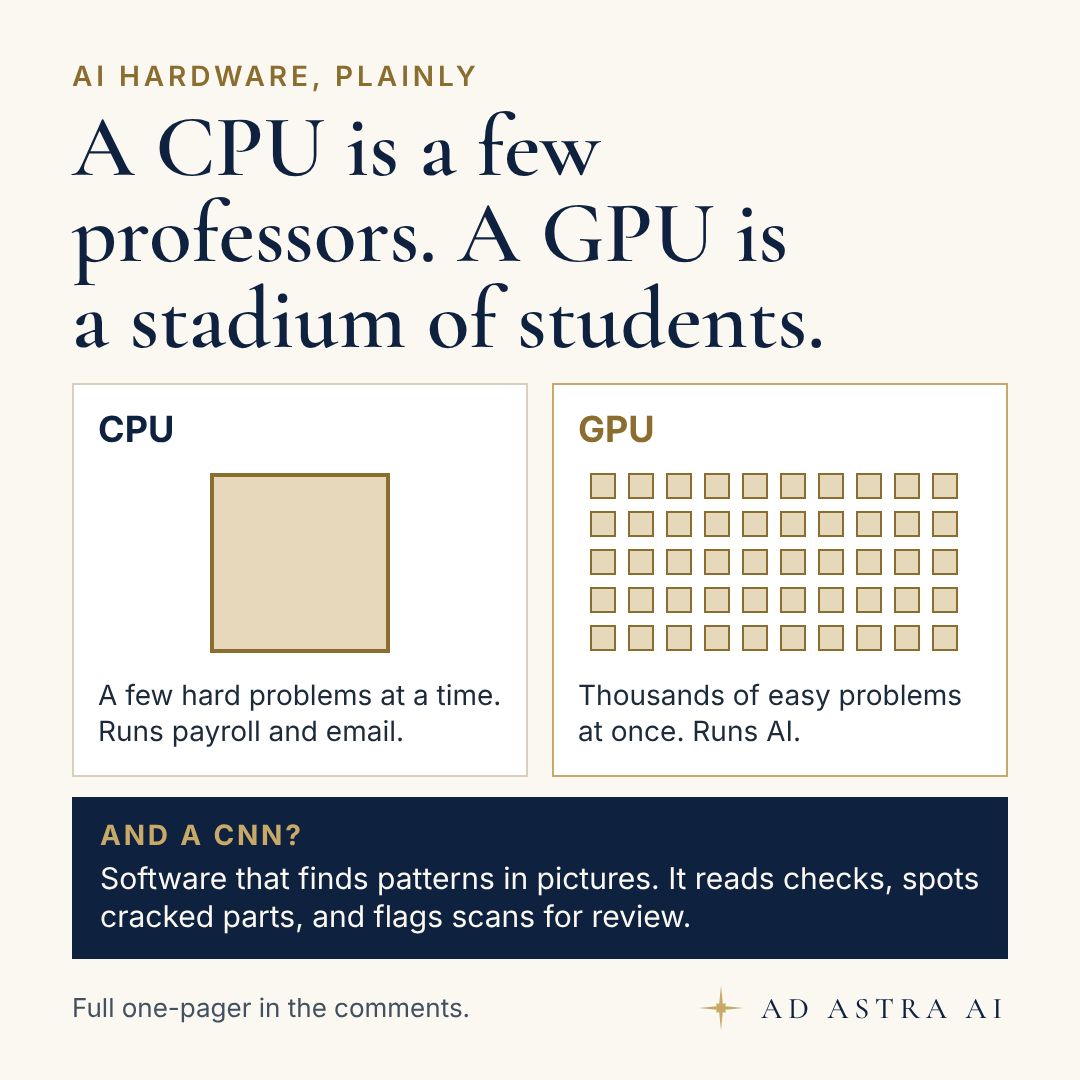
A CPU is a few professors. A GPU is a stadium of students. A CPU works on a few hard problems at a time and runs payroll and email. A GPU works on thousands of easy problems at once and runs AI. A CNN is software that finds patterns in pictures.
The three terms

CNNs

Convolutional neural networks
What it is

Software that finds patterns in images. Small filters scan a picture for edges, then shapes, then whole objects.

What it does

Reads amounts on scanned checks. Flags cracked parts on a production line. Highlights suspicious spots on a scan for a clinician.

Why it matters to you

It turns manual image checking into a fast first pass. Ask any vendor what it was tested on and what its error rate is.

GPU vs. CPU

The chips that run AI
What it is

A CPU is a few brilliant professors, each solving hard problems step by step. A GPU is a stadium of students doing simple math at the same time.

What it does

The CPU runs payroll, email, and your website. The GPU trains and runs AI, which means billions of simple multiplications in parallel.

Why it matters to you

AI cost is driven largely by GPU time. Training a model takes huge GPU clusters. Running it for every customer request takes GPUs too, so cost grows with use.

Quantum computing

A specialist tool, still maturing
What it is

A different kind of computer built on qubits, which can hold a blend of 0 and 1. A specialist tool, not a faster laptop.

What it does

Expected early uses: simulating molecules and materials and, once large, error-corrected machines exist, breaking today's public-key encryption.

Why it matters to you

Intercepted or stolen encrypted data can be stored now and cracked later. The US standards agency NIST finalized its first post-quantum standards in August 2024.

Why it matters

Five things that reach your budget, your risk, and your timeline.

01

Your AI bill follows the hardware.

AI cost is driven largely by GPU time. Training a model is a capital project. Inference, answering each request, is a utility bill that grows with use. Power, memory, and networking add to it.

Most businesses never buy a chip. They rent AI by the use, and the price reflects what the chips and the power cost. Ask any vendor how your price changes as your usage grows.

02

Capacity is scarce, and priced that way.

Company guidance reported with April 2026 earnings put the 2026 capital spending plans of Alphabet, Amazon, Microsoft, and Meta at roughly $700 billion or more, with company commentary pointing mostly to data centers and AI infrastructure. Nvidia, the leading AI chip maker, reported $215.9 billion of revenue for its latest full fiscal year (ended January 2026), up 65%, with about 90% from data center products.

When the biggest buyers compete for the same chips, everyone downstream feels it in price and availability.

03

Electricity is increasingly the bottleneck.

Gartner projects that data centers will use 565 terawatt-hours (TWh) of electricity in 2026, up 26% from 447 TWh in 2025, and that AI-optimized servers will account for 31% of data center power use. Gartner also says power availability now constrains AI capacity.

Computers can be built faster than power plants and grid connections. Power, not only chips, increasingly sets the pace.

04

The supply chain is narrow, and the rules keep changing.

Leading AI chips are made mostly by TSMC in Taiwan. The specialized high-bandwidth memory (HBM) they depend on comes from a few makers, chiefly SK Hynix, Samsung, and Micron.

Since October 2022 the US has restricted exports of advanced AI chips, mainly to China. Nvidia's CEO said in October 2025 that its China AI-chip share had fallen from about 95% to near zero. Limited licenses for Nvidia's H200 chip were granted in 2026, first shipments to China were reported in August, and Nvidia's guidance assumes no China data center compute revenue. These rules change often, so check current guidance before you rely on any of this.

05

Data stolen today may be readable later.

A large, error-corrected quantum computer could break widely used public-key encryption such as RSA and elliptic-curve schemes, the locks behind most secure web traffic. Symmetric ciphers like AES are much less affected. Machines that can do this do not exist yet, and public roadmaps point to the late 2020s or early 2030s. Treat those dates as targets, not promises.

The risk starts earlier, because adversaries can store encrypted data now and decrypt it later. NIST finalized its first post-quantum cryptography standards (FIPS 203, 204, and 205) in August 2024. List the data that must stay secret for ten years or more, and ask your vendors how they plan to move to the new standards.

What to do Monday

Three questions to ask before you buy or approve anything AI.

  1. 1What was it tested on, and how does it fail?
  2. 2Where does it run, and what happens to cost as usage grows?
  3. 3Which of our data must stay secret for ten years or more?

Buy outcomes and workflows, not hardware.

Book a 30-minute scoping callFind out where you stand
Sources